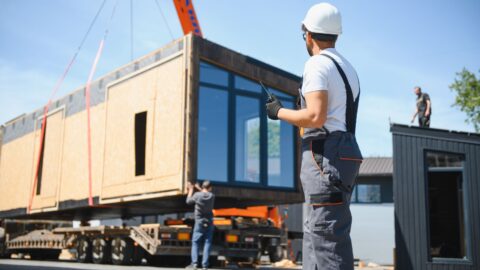
Biobased building touches on several domains simultaneously: agriculture, construction, industry and spatial planning. It requires the development of new production chains for natural raw materials, adapted building logistics and processing capacity tailored to biobased properties. This is not an obstacle, but an opportunity, writes Jan Willem van de Groep on the eve of the two-day Climate Summit Built Environment.
The construction sector is the fastest growing source of carbon emissions worldwide. New research from Bauhaus Earth and the Potsdam Institute (2025) shows that the carbon footprint of construction has doubled in 30 years and now accounts for one-third of all global emissions, even without counting the energy use of buildings. Cement, steel and brick are the main culprits and together they cause more than half of the emissions.
If current trends continue, construction alone will have consumed the entire remaining 1.5-degree global carbon budget by 2050. Not because more is being built, but because the same materials are still being built. Emissions fluctuate with the business cycle but do not structurally decrease.
The European picture can also be gleaned from this report. When the entire chain is included, from material production to import, construction's share of total emissions is around 23 percent. Much higher than is often assumed. This makes construction not marginal, and thus one of the most powerful levers to meet climate goals.
From regulation to climate control
The European approach is fundamentally tilting. Whereas previous directives such as the Construction Products Regulation (CPR) focused mainly on comparing environmental impact on a product-by-product basis, the new Whole Life Cycle Global Warming Potential methodology (WLC-GWP) is betting on direct and demonstrable CO₂ reductions over the entire life cycle of buildings. Initial analyses show that the greatest climate impact thereby occurs at the front end of the production process.
The WLC GWP gives member states space to emphasize emission reductions in line with their own climate path. That space is crucial because the European goals are clear: at least 55 percent reduction by 2030 and at least 90 percent by 2040. In that time frame, what we build today counts, with what materials, and how quickly emissions can fall. Steering by material choice, negative emissions and chain impact thus becomes inevitable.
Building as an active climate solution
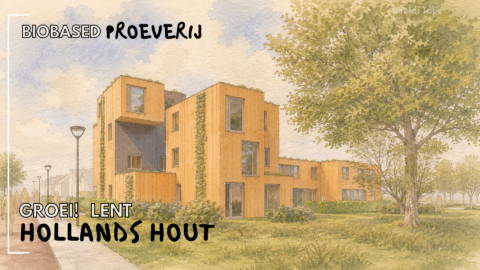
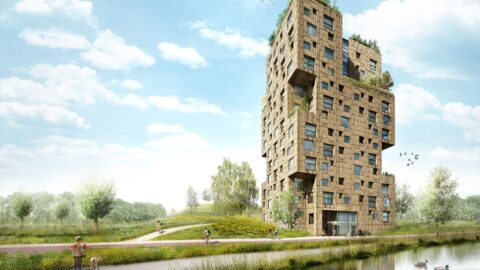
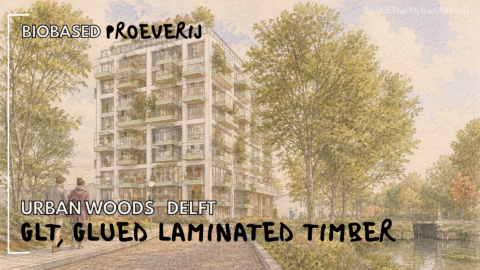
Biobased materials offer a unique combination in this regard: they replace emission-intensive raw materials while sequestering CO₂ in buildings. Wood, flax, hemp and other fiber crops remove CO₂ from the atmosphere and retain it for decades in structures, insulation and finishes. That storage is measurable, verifiable and physically present in our built environment.
Per ton of CO₂ avoided, biobased applications are also extremely cheap. Whereas industrial capture and storage often costs above one hundred euros per ton, the social cost of bio-based carbon storage is under fifty euros per ton, according to recent calculations. Construction can thus not only reduce emissions, but also provide active carbon removal, a key component of European climate policy after 2030.
Yet these climate gains are still under-appreciated. While reuse or recycling of steel and concrete in the distant future is now often counted as profit, in the case of biobased materials it is assumed that all stored CO₂ will be released again over time. This leads to an unbalanced picture in which fossil materials are favored and storage capacity of natural materials is left out of the picture. This is not only technically incorrect, but also untenable in policy terms if we really want to steer towards climate impact before 2030 and 2040.
Another form of industrial policy
This change requires more than an adjustment in calculation rules. It is part of a broader shift in our industrial policy. Anyone who takes climate goals seriously must also fundamentally rethink value chains, production capacity and standardization.
Biobased building touches on several domains simultaneously: agriculture, construction, industry and spatial planning. It requires the development of new production chains for natural raw materials, adapted building logistics and processing capacity tailored to biobased properties. This is not an obstacle, but an opportunity. Building these chains domestically creates economic value, less import dependence and direct climate gains.
Commitment to materials must become as natural as commitment to hydrogen, nuclear power or grid reinforcement. Climate policy becomes industrial policy. And material choice is not a detail, but a strategic decision.
Box | The scale of biogenic storage
A plant processing the annual harvest volume of 7,000 hectares of fiber crops could reduce about 1 megaton of CO₂ in 10 years. When scaling up to 50,000 acres, that rises to over 0.7 megatons per year, and at 100,000 acres to about 1.4 megatons per year. That does not include the climate gain from wood, which is already partly accounted for in European climate accounting and is at least as large. Based on recent explorations, the combined climate gain from biobased materials, under active stimuelring, through storage and displacement could be about 2.5 to 3 megatons of CO₂ per year in 2030, rising to 4 to 5 megatons per year in 2035. By comparison, material-related emissions from Dutch housing construction are around 4 to 5 megatonnes of CO₂ per year.
This article was written by Jan Willem van de Groep, programmer, future thinker and publicist. He is known, among other things, for the government program Building Balance.
Want to respond?
Would you like to respond to this article? Or would you like to share something here? Please send an email to Thomas van Belzen, editor-in-chief of Bouw & Installatie, at Thomas.van.belzen@jaarbeurs.nl