This week, expedition leader Marjet Rutten takes you to the demolition site, where raw materials for new concrete are unexpectedly found beneath the rubble.
Concrete is still the construction industry’s darling. Strong, versatile, and available everywhere. But it comes with a serious climate problem: globally, concrete is responsible for about 8 percent of CO₂ emissions.
While 21 developers made commitments this month at the Provada real estate fair to use more low-carbon concrete, a Dutch innovation shows that sustainability sometimes literally lies in the rubble. At Freement, they no longer view old concrete as waste, but as a raw material for new, high-quality concrete.
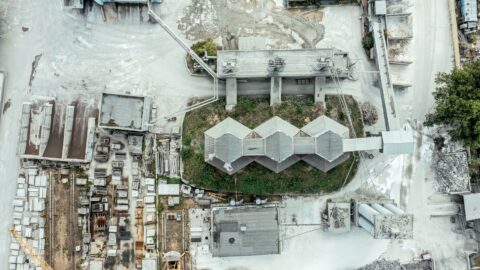
From demolition waste to a raw materials plant
The construction industry faces a twofold challenge: reducing CO₂ emissions and using scarce raw materials more efficiently. That is precisely why circular concrete is gaining more and more attention.
With the help of the so-called Smart Liberator, demolished concrete isn’t simply ground down into foundation material, but carefully separated. Sand, gravel, and even unhydrated cement particles are recovered and reused in the production of high-quality concrete.
That’s a major step forward. Traditionally, concrete often ends up being “downcycled”—for example, as fill under a road. Here, however, it becomes a fully-fledged substitute for new raw materials.
The results are striking: the process yields a CO₂ reduction of approximately 63 percent compared to traditional concrete. Moreover, the facility runs on solar energy and uses rainwater in the production process.
At a time when the sector is aiming for a 70 percent reduction in CO₂ emissions by 2030 through the Concrete Agreement, this technology demonstrates how circularity can be put into practice.
The Smart Liberator Survival Kit
-
t
- Smart sorting technology
-
t
- Concrete is separated into sand, gravel, and cement components.
- This helps preserve high-quality raw materials.
t
- Not downcycling, but recycling
-
t
- The material is reused to create high-quality new concrete.
- This reduces the need for primary raw materials.
t
- 63 percent fewer CO₂ emissions
-
t
- Reusing existing materials significantly reduces the environmental impact.
- Solar-Powered Production
-
t
- The facility runs largely on renewable energy.
- This reduces emissions from the recycling process itself.
t
- Use of Rainwater
-
t
- Water consumption is also factored into the circular design.
- An example of integrated sustainability.
t
t
t
t
t
Survival Tip
The real breakthrough lies not only in the technology, but above all in the supply chain surrounding it. The agreements developers recently made at Provada show that demand for circular and low-carbon concrete is growing. That’s crucial, because without clients who actually specify the material, even the smartest innovation will get stuck in the pilot phase.
Still, the biggest challenge lies in the process itself. Circular concrete doesn’t start at the recycling plant, but at the building being demolished. All too often, the demolition hammer is brought in without first considering which materials can be preserved and recovered.
The lesson for the industry: treat today’s buildings as tomorrow’s raw material bank. The smarter we demolish and collect, the more valuable the materials that return to the construction cycle.
About the Smart Building Expedition

Construction is like surviving in a jungle of rules, ambitions, and problems. In “Expedition Smart Building,” Marjet Rutten takes you every week to a groundbreaking place or location where they’ve overcome all the obstacles and hurdles along the way. If you also have a special place you’d like to highlight, please email the editorial team.
Rutten has been working in the industry since 1998 and wants to contribute to a dynamic, successful construction sector. In addition to her work for Building Balance, she is active as a Gideon and serves on numerous government review committees and juries, where her responsibilities include assessing the market potential of planned product and process innovations. Her latest book, *From Brick to Blockchain*, about developments in the sector leading up to 2040, can be ordered here. Looking for more inspiration on developments in our sector? Visit www.debouwin2040.nl