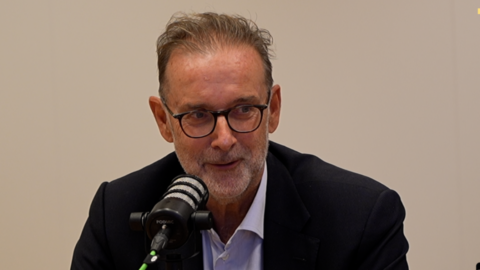
Dura Vermeer's mission is to build sustainably, which is why they want to halve CO2 emissions by 2030 and reduce them to zero by 2050. You can't achieve that by continuing to do what you're already doing, so the construction company is busy innovating. One of the sustainable new concepts is Aer, a residential concept based on wood construction that incorporates as many sustainable innovations as possible. We spoke with Maurice Hadderingh, the inspired innovation manager and initiator of the project. He sees opportunities to save CO2 everywhere, but he is also a realist. We just had to start somewhere.
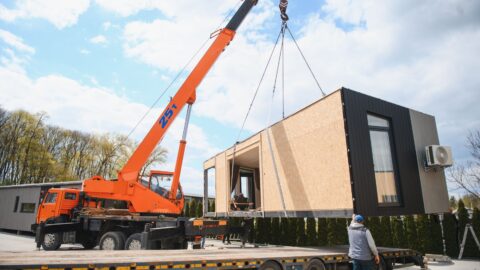
In Apeldoorn, Maurice is showing us around the Aer homes that Dura Vermeer has put up there as a pilot, which can stay for two years. One of them is neatly furnished; in the other, new materials may be experimented with. He points out to us the parts that have already changed since construction. For example, testing has been done with different materials in the ceilings and with circular plumbing and biobased wall coverings in the bathroom. The steel interior door frames will soon be replaced with a more sustainable version. The installation has also been modified, as the ventilation heat pump was somewhat underpowered in practice.
Sessions with suppliers
A total of 168 areas of concern were identified in the pilot houses, Maurice says. 'These are not only points where it is less sustainable than we want, there are also some that make it more financially unattractive. My tactic is to just start and then improve and improve and improve and improve. If you want to figure everything out before you start, you'll never get anywhere.'

We don't produce ourselves, but we have taken responsibility, down to the last boltMaurice Hadderingh
All of Aer is conceived together with partners, Maurice explains. 'We have structural long-term collaborations. Together we held sessions in which they actively thought about how things could be done better.' This often involved very practical matters. For example, the partner for the kitchens has to think along about the module that contains that kitchen, which is the first to be put in place. 'But what if you start hoisting that module and a kitchen cabinet flies open? That comment then comes from a party you didn't expect at all. By working together in this way, we have eliminated many potential problems in advance.'
The Virtual Factory
The importance of the partners is highlighted by the fact that the builder works with them very differently from other industrial builders. This is because Dura Vermeer does not have its own factory, but has everything produced and delivered by suppliers, after which they assemble it themselves on site. To do that properly and efficiently, they have digitized the housing concepts in their Virtual Factory. 'Digitalization is central,' Maurice states. 'We don't produce ourselves, but we have taken on the responsibility, down to the last bolt.'
The fact that they don't have their own factory is, in Maurice's opinion, mainly a strength. It enables Dura Vermeer to implement new production methods or building materials quickly. 'If, for example, a new bio-based insulation material is invented, we can implement it quickly. We don't have to disrupt a well-oiled machine for that because we have to adjust a production line. We can easily take full advantage of innovations from our partners. Because a flooring manufacturer wakes up with a great idea about a floor. We don't, we are builders. They innovate in that, and we then put the whole thing together. The demand is high, and so we need all the expertise we can get.'
Social housing
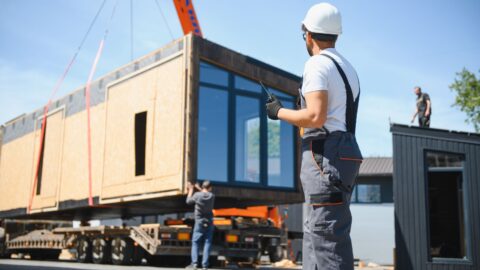
Aer is a housing concept based on two ready-made modules containing the kitchen, bathroom, staircase and installations. These are put down first, after which different rooms are assembled around them and the roof is put on. In principle, anything is possible around these modules, but in order to keep production efficient, this too must of course be standardized as much as possible.
The construction company plans to start quietly this year with the 50 Aer homes already in the portfolio. Then they want to double that number by 2026, after which they will build up to 200 homes of this type on an annual basis. In doing so, they will focus mainly on social renting, low middle renting and social buying. "That's where the biggest shortage is, and we want to build what's needed," Maurice points out. They are also working on range expansions for other market segments, and with that they are trying to scale up to a maximum capacity of around 1,500 homes per year in the coming years.
We want to build what is neededMaurice Hadderingh
HSB and concrete
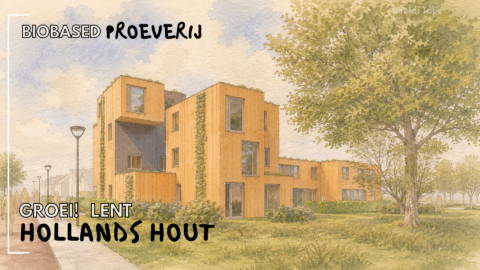
In Aer, Dura Vermeer is using timber frame construction. Everything is thought about how to make it as sustainable as possible. Maximum detachability and with as few CO2 emissions as possible. But in doing so, Maurice remains realistic. For example, the question arose whether the floor on the first floor should not also be made of wood. 'That has been completely thought out and engineered,' he says. 'But we don't dare apply it yet, partly because of the rising groundwater levels. That's why part of the floor is now still made of concrete. That's not what we want for the long term, but realistic for now.' The middle section of the house, however, has a floor of biobased composite. 'That's really distinctive and innovative,' he adds.
As it is always done
The way in which the housing concept is becoming sharper and sharper and learning from experience is evidenced, among other things, by what is standard on the roof.
When it comes to the roof, Aer currently comes in two flavors: a flat roof and a pitched roof. On the flat roof, a green roof is the standard. A green sloped roof is also on the shelf, Maurice points out. 'That's just complex and it therefore drives up the price. So it's still tiles, but our preference was for reused tiles. In new construction, those are hardly used anymore, and it also requires a lot from us to make them available. But the production of a roof tile is very carbon intensive, and using second-hand gives as much as 96 percent savings. Even if those roof tiles from the demolition site in the Achterhoek are first transported to Limburg for processing and storage and then to Groningen where they are put back on a house.'
Still, there are new tiles in Apeldoorn, Maurice explains a little embarrassed. 'That went wrong. In the speed of arranging, that was done as it was always done. But that's why we made those reused roof tiles standard now. That's one of the things we learned from this pilot. That's how we keep learning more and more and that's how we keep taking some CO2 off," he concludes. He beams when he says it, because that's exactly what he signed up for when he took this job.
This interview was created in collaboration with Ubbink.
This is an article from Construction and Installation Hub. Want to keep up with all the news from the construction and installation industry? Then take a look at the hub and sign up for the online community.
↗