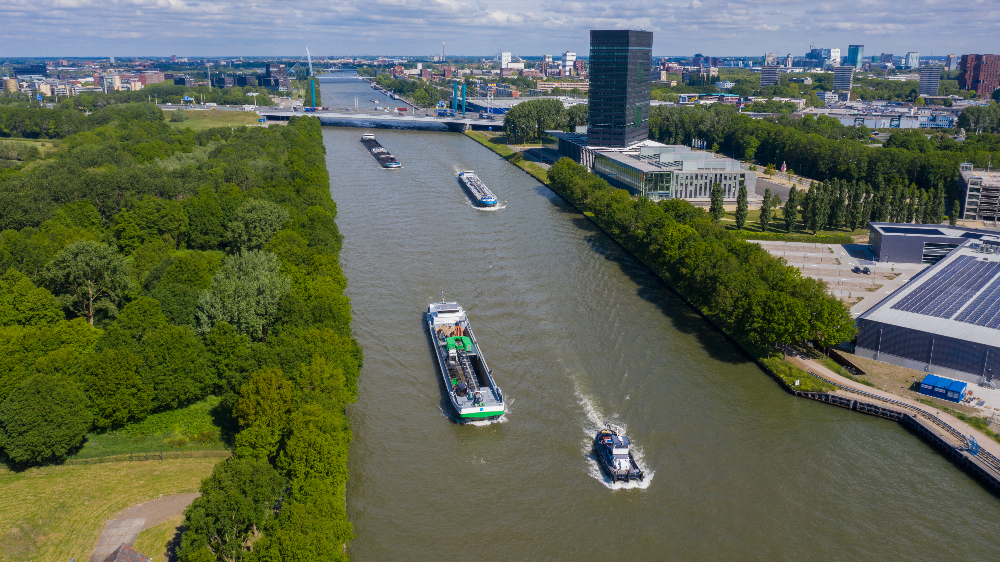
The persistent drought is making the transport of construction materials via Dutch rivers more expensive and more difficult. How is the sector already being affected by these historically low water levels, and what will happen if the drought continues after the construction industry’s summer break?
Precipitation in July was much lower than normal. According to Rijkswaterstaat, water levels in both the Rhine and the Meuse are at historically low levels. Little precipitation is expected in the coming weeks as well. Water levels in the Rhine may rise slightly, but are expected to remain extremely low.
100 metric tons less cargo per 10 centimeters
The decreasing navigable depth means that inland waterway vessels can carry lighter loads, explains Koninklijke Binnenvaart Nederland (KBN). “As a rule of thumb, for every 10 centimeters of reduced navigable depth on the Rhine, a ship can carry approximately 100 metric tons less cargo, although this varies by ship and route.”
“To get the same amount of goods to their destination, more trips are needed and transportation costs increase. In practice, a low-water surcharge is often applied, which passes on the additional transportation costs to the client.”
Sand, gravel, cement, and steel
The trade and logistics association evofenedex also noted in a statement that the supply of construction materials is among the sectors most affected by the limited navigability. “Ships can carry less cargo, which means more trips are needed. This can then lead to longer delivery times, higher costs, and ultimately delays on the construction site when supplies cannot be replenished on time.”
Switching to trucks or rail is by no means always a solution. The volumes are sometimes too large for that, or a rail connection is lacking. Where an alternative is possible, transport costs can be two to three times higher, according to evofenedex. Furthermore, a “waterbed effect” arises: goods that are no longer transported by water place additional pressure on the already congested road network.
Construction industry slowdown mitigates the impact
Although the drought is indeed beginning to impact inland waterway transport, the Dutch construction industry does not yet seem to be feeling the effects on a large scale. There is a logical reason for this: it is the construction industry’s summer break, and many construction sites are currently at a standstill.
Bouwend Nederland reports that it has not yet received any direct signals from the sector, aside from the consequences of the closure of the Twente Canals, which have been completely blocked since July 25. Rijkswaterstaat has also imposed a ban on water extraction there to prevent damage to the flood defenses. KBN previously estimated that a two-week closure of the Twente Canal would result in approximately 1.8 million euros in economic and social costs.
Stop treating drought as an isolated incident
Inland waterway shipping is accustomed to dealing with low water levels, as KBN explains. “Operators load their ships differently, adjust sailing schedules, and tailor their planning to the available navigable depth. There are also ships that have been specifically designed to carry a relatively large amount of cargo even at low water levels.”
But according to KBN, simply making adjustments when water levels are low is not enough. The industry association expects periods of extremely low water levels to occur more frequently and therefore advocates for a long-term approach. Bottlenecks and shallow areas must be addressed systematically, and decisions regarding water safety, nature, and freshwater must also take into account the navigability of rivers.
Logistics Alert
Evofenedex also believes that companies must systematically factor low water levels into their logistics planning. This means, for example, taking a critical look at inventory levels, mapping out alternative routes in advance, and reevaluating their reliance on a single mode of transportation. “We should no longer treat this risk as an isolated incident, but rather incorporate it systematically into our logistics planning and supply chain strategy,” evofenedex summarizes the challenge.
For the construction industry, the drought thus appears to be a logistical warning for the time being. The real test will come after the construction industry’s summer break. If rainfall remains scarce while construction sites are back in full swing, higher transportation costs and more difficult-to-navigate waterways could have a more pronounced impact on the supply of construction materials.