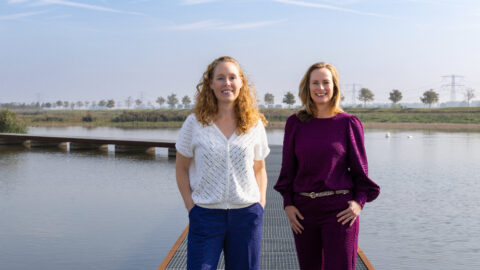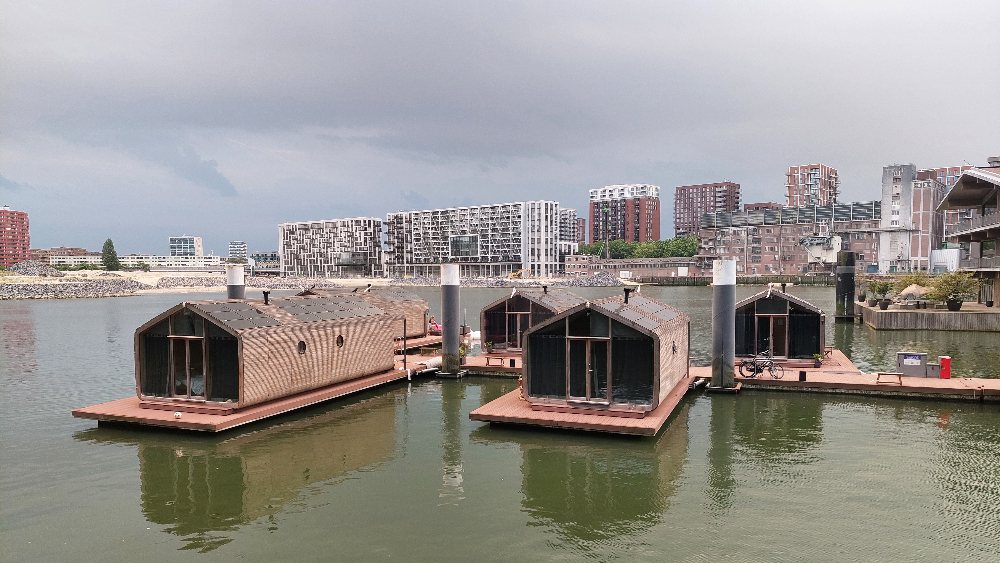
Affordable, multi-story housing on the water comes with its own set of challenges. The main one—unsurprisingly—is outdated legislation, says Chantal van Tatenhove, a researcher at De Drijvende Kracht. Still, she sees plenty of opportunities on the water. “Floating housing needs to be given much more attention in area development plans.”
DDK develops floating housing solutions using scalable and affordable concepts. That certainly makes van Tatenhove happy. She herself lives on a houseboat in Utrecht, and her enthusiasm for floating housing has led her to pursue it professionally as well.
Chantal, why does floating housing make you so happy?
“It’s the challenge of connecting the city and nature more closely: building and living in harmony with nature. We desperately need to pay much more attention to green spaces in cities, because a green environment has a positive impact on people’s well-being. The June heat wave and the associated heat stress have once again forced us to face the facts. In urban development projects, green spaces are a serious consideration. And more water and living on the water are also ways to bring nature closer to us.”
You know that from experience, right?
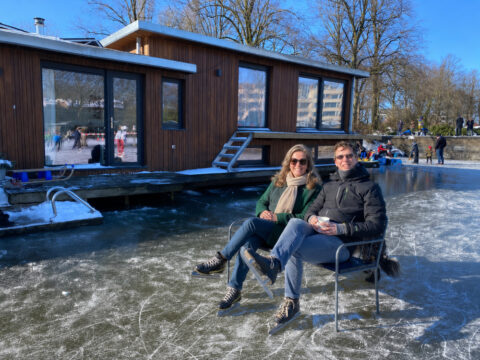
“That’s right. I’d long wanted to live in the city while being surrounded by nature. That’s quite a challenging combination. A few years ago, I saw a houseboat for sale in downtown Utrecht. It was actually too small for our family, but I saw the potential. And I saw all the greenery and the wildlife around the houseboat. For us, it was a once-in-a-lifetime opportunity. We expanded the houseboat from 80 to 125 m² and have now been living on the water for seven years. Water and greenery bring peace and coolness. I wish more people could experience this.”
Are there any downsides to living on the water?
“There are people who just don’t like that constant rocking, so for them, living on the water isn’t an option. And well, living on the water is different from living on land. When it comes to DIY projects and renovations, you might as well throw away your level. When furnishing a houseboat, you have to take the weight of the furniture into account. For your own comfort and for the plumbing systems, it’s best to be level. And all your wastewater is pumped up to the dock. You don’t even want to think about that pump breaking down…. And in the winter, of course, it’s incredibly idyllic to step right out of the kitchen onto the ice, but you’ll also have to keep all your plumbing frost-free. Anyway, those issues are all solvable.”
What is your perspective on floating housing?
“When I moved here, I got in touch with SUWO (Stedelijk Utrechts Woonschepen Overleg), the advocacy group for houseboat residents in Utrecht, of which I am now the chair. I also founded my company, Binnenboord, which focuses on developing innovative housing concepts, including those related to living on the water. As an expert by experience, a real estate agent, and drawing on my background as a social geographer, I believe that floating housing deserves much more attention in area development plans. The combination of city and nature is one reason, but climate change and rising sea levels are also a ‘driving force.’”
To what extent is this issue already receiving attention?
“The issue of sea-level rise caused by climate change is raising awareness. This movement is growing rapidly in the Netherlands. The fact that the construction challenge in the Netherlands is substantial and available building land is scarce is also leading people to ask more often: why don’t we build on the water? One organization that’s already well advanced in this area is De Drijvende Kracht. DDK was founded by visionary René Breman and develops floating housing solutions that address the housing shortage and make the Netherlands resilient to climate change. They do this with scalable and affordable concepts, ready to be built. “To literally put floating housing on the map within area development, I joined DDK as an explorer.”
What does your role as an explorer entail?
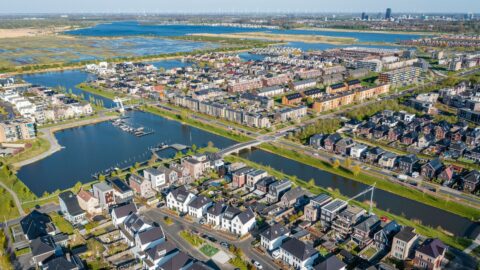
“I engage in discussions with municipalities and other interested parties, and together we explore potential locations for floating housing. That involves a lot of lobbying, a lot of talking, consulting, and visiting sites. The Netherlands is a country rich in water, so there are opportunities everywhere. You might first think of riverbanks and docks, but the many sand and gravel quarries are also excellent locations. In addition to the construction challenge, water storage is a major issue in the Netherlands. And as it happens, floating homes and water storage make a great combination! I’m truly convinced that we can tackle a number of challenges through the multifunctional use of space.”
Are there already concrete examples of floating neighborhoods?
“So far, mostly small-scale projects have been completed, such as the thirty houseboats in Amsterdam and the eighteen houseboats in Rotterdam. But those are luxury homes—not affordable solutions. There are relatively many companies in the Netherlands that can build villas and lofts on the water. But affordable, multi-story housing on the water presents different challenges. In May, the Floating Housing Manifesto was presented to the House of Representatives Committee on Spatial Planning and the Environment. The projects are ready to go. But outdated legislation is holding us back. One of the municipalities committed to housing with and on the water is Zwolle. The municipality wants to build homes that move with the water levels. Hopefully, more and more municipalities will take a fresh approach to the housing challenge, incorporating waterfront lots into the range of housing options. That makes me very happy.”
So, social housing on the water?
“Absolutely! The projects that have been carried out so far were aimed at homeowners. But much more needs to—and can—be done. The massive housing challenge we face calls for a bold approach—both for-sale and rental housing, on land and on the water. If you implement floating housing concepts on a large scale, you can make significant strides. Rental housing on the water is a wonderful way to serve a different target group. We at DDK are fully on board with that. There are also opportunities for social cohesion, for example in the form of a shared laundry room, a (floating) vegetable garden, and so on. So it’s a win-win-win situation.”
Do you see any other opportunities?
“There are many small, old harbors in the Netherlands. They’re ideal for smaller projects, student housing on the water, or for people in urgent need of housing. Because the units float, they can be moved very easily. We build sustainably and using a modular approach, so we can adapt easily.”
It’s quite a project to take stock of all the locations and opportunities. It takes time, but I’ve noticed that municipalities and other landowners are definitely interested and, in general, willing to make floating housing a reality. We want to roll out the “Drijvende Kracht” concept. If there are changes to laws and regulations, we’ll be able to make living on the water possible for an even broader target group.”
About Vrolijk Bouwnieuws
Do you have news that makes you happy? And would you like to share it with the rest of the world? Don’t hesitate—bring it to our attention and email the editorial team.
Looking for more Cheerful Construction News? You can find it here.