How can you cope with the housing shortage if new construction alone isn’t happening fast enough? By looking not only at building lots, but also behind existing front doors. STUT Consult shows that you don’t always have to split up a home to do this. Sometimes it’s better to learn to share.
The Netherlands is frantically searching for space for housing. Last week, that search received another boost: TKI Bouw en Techniek is making €3 million available for innovations related to adding stories, subdividing, reconfiguring, and transforming existing buildings. It makes sense. After all, why build only new square meters when existing square meters can also be put to better use? It’s faster, cheaper, and a lot more sustainable.
Shared Housing
But there’s another option: share the home without necessarily turning it into multiple independent units. One building, multiple households. STUT Consult has been involved in communal living and shared ownership for over forty years. Think of a large home, farmhouse, or other building where multiple people or households live. Residents can have their own private space while also sharing common areas and amenities. The balance between private and shared spaces varies by project.
That sounds simple. Legally and financially, however, it certainly isn’t. Because as soon as three, four, or more people want to jointly purchase and live in a property, they no longer fit neatly into systems designed for one household per home. Financing, ownership, permits, changes in membership, and mutual agreements all require different arrangements.
One option is a housing cooperative. In this model, the building isn’t necessarily divided into separate apartments for land registry purposes. Residents are joint owners and agree on the use of private and common areas. This opens up an interesting path: making more intensive use of existing buildings without having to build a completely new, independent home for every resident.
From one house to more homes
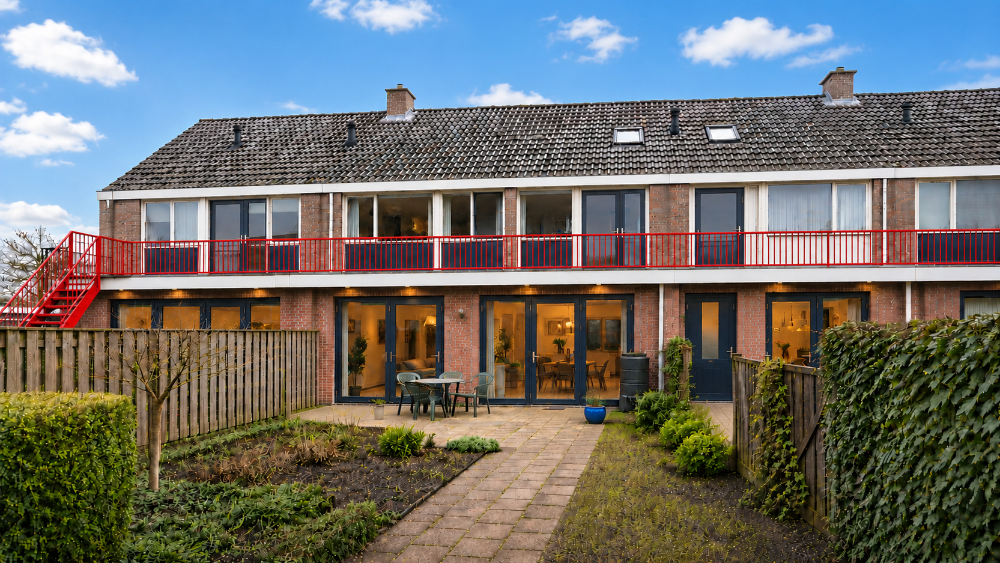
That idea aligns remarkably well with another development in the news this week: “Benut de Overruimte” (Utilize the Extra Space). This initiative by Holland Houtland explores how unused space in existing homes can be repurposed to create additional living space. This year, it ranked 5th in the Housing & Energy category of the Trouw Sustainable 100. One of the solutions from the challenge is the “Woningverdubbelaar” (Home Doubler), developed by FDarchitecten and others. This involves modifying existing row houses so that one home can be converted into two living spaces.
In one approach, space is physically added or subdivided. In the other, existing space is shared. In both cases, the search doesn’t begin with the question: Where can we build? But rather : What space do we actually already have? And that very question is becoming increasingly relevant now that the Netherlands is grappling not only with a housing shortage but also with a scarcity of building land, labor, grid capacity, and materials.
The Survival Kit for Making Better Use of Existing Buildings
-
t
- Existing square meters are being turned into living space. Large homes, farms, and other buildings can be shared by multiple people without automatically having to build a completely new home for every household.
- Private and communal spaces are combined. Residents decide which areas are private and which amenities they share—from the living room and kitchen to the garden, guest room, or workspace.
- Not every solution requires splitting a home. Joint ownership can be an alternative when several people want to live together sustainably in a single property.
- Sharing can go beyond square meters. Investments in solar panels, heat pumps, mobility, maintenance, or a garden, for example, can also be organized collectively.
- The solution aligns with the current search for “extra space.” While €3 million is being made available this week for innovations in adding stories, subdividing, and repurposing buildings, this approach demonstrates that making better use of existing buildings can also be a form of social and organizational innovation.
t
t
t
t
Survival tip: Don’t start with the bricks—start with the rules of the game.
Anyone who wants to share space must discuss in advance what remains private, what becomes shared, how decisions are made, and what happens if someone moves out. That sounds less spectacular than a large new construction project that serves as an eye-catcher. But with communal living, a significant part of the innovation isn’t in the building itself. It lies in the agreements between the people who live there.
About the Smart Building Expedition

Construction is like surviving in a jungle of rules, ambitions, and problems. In “Expedition Smart Building,” Marjet Rutten takes you every week to a groundbreaking place or location where they’ve overcome all the obstacles and hurdles along the way. If you also have a special place you’d like to highlight, please email the editorial team.
Rutten has been working in the industry since 1998 and wants to contribute to a dynamic, successful construction sector. In addition to her work for Building Balance, she is active as a Gideon and serves on numerous government review committees and juries, where her responsibilities include assessing the market potential of planned product and process innovations. Her latest book, *From Brick to Blockchain*, about developments in the sector leading up to 2040, can be ordered here. Looking for more inspiration on developments in our sector? Visit www.debouwin2040.nl