In the Netherlands, bamboo isn’t widely used in construction yet—and certainly not as a load-bearing material. But that’s about to change, as Ronald Rovers explains in this Post Fossil Construction article. Get ready for it.
About 1 in 8 people in the world lives in a bamboo home—that’s 1 billion people—and they’re completely satisfied. Okay, most of them live in subtropical climates, where conditions are ideal for using raw bamboo stalks. That’s not going to work here, but it doesn’t have to. Bamboo can easily be processed into materials suitable for construction even in our climates. With standardized dimensions, so it can be integrated into the construction process. This is what’s known as engineered bamboo.
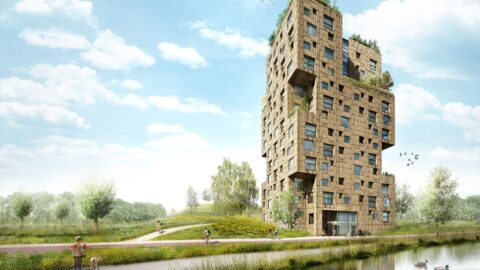
That future is getting closer and closer. And I’m talking about building with bamboo as a load-bearing structural material. As seen in the Ninghay Bamboo Tower: the first multi-story building in which engineered bamboo has been used as a load-bearing material! It’s located in China—where else?
For the Chinese building, they based their calculations on figures for wood, and tests apparently show that it meets all expectations. Although I haven’t been able to find any definitive scientific publications yet. But after some single- and double-layer experiments with engineered bamboo, there’s now a serious building standing there, and no one can ignore it anymore.
Back in the Netherlands, there is still no proper classification, nor are there any tests for engineered bamboo varieties intended for structural use. Here, it’s still classified as grass, not wood. Up until ten years ago, we worked closely with Chinese partners at WUR and Zuyd on this. The focus was primarily on SWB5g,fifth-generation strand-woven bamboo. These are compressed fibers, and in principle, they’re extremely strong. Its tensile strength approaches that of steel. The problem is that there is not yet a safe, strong adhesive for that variant. But in most cases, that isn’t necessary at all, and laminated bamboo suffices. For Lamboo and CLB (Cross-Laminated Bamboo), that adhesive is available.
There’s a lot more happening in the world of bamboo. A number of organizations regularly publish articles on bamboo structures, using both raw and engineered bamboo. Just look up the Base Bahay Foundation or Greezu, and in the Netherlands, check out Pablo van der Lugt. He had some more news: the World Bamboo Conference is coming to the Netherlands in June 2027.
This offers a great opportunity to give bamboo a strong start in the Netherlands as well. And reportedly, an ISO standard for laminated bamboo is coming out this year; new adhesives are being developed, and in some countries, structural or load-bearing use is already possible under existing wood standards.
And then there’s CLB, as a variation on CLT. Of course, you should only use these two where those solid panels are truly necessary. Often, HSB—or soon, BSB (Bamboo Frame Construction)—will suffice as the more material-efficient option.
Growing bamboo in the Netherlands? There’s already a lot of experimentation going on there, and it turns out that its rapid growth can be easily controlled. It turns out that bamboo yields 4 to 5 times more per hectare per year than wood. It’s much stronger and has an enormous capacity to store CO2.
Bamboo—it’s on its way!
About the author of this column, “Post-Fossil Construction”
Ronald Rovers is a former professor, physical fundamentalist, futurist, and now an author, on a quest for the ultimate sustainable physical balance on Earth—without fossil fuels, of course. He calls Productive Land “our true capital, for food, energy, water, and materials. And that requires us to live ‘vegetarian’—and therefore also to build vegetarian. In that light, I explore the future of construction here.” More on this. You can read Rovers’ contributions here. Or visit his own website.