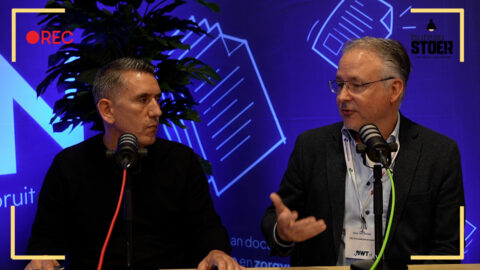
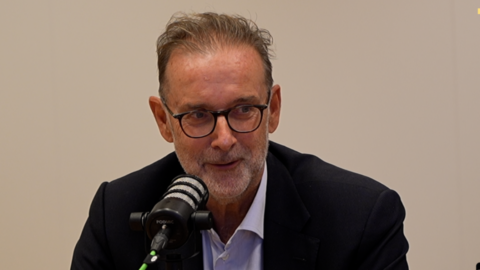
Circular renovation is a challenge, says Sam Nederend, materials transition advisor at De Alliantie. They decided to organize a challenge, and it yielded some great ideas. “And that’s Vrolijk Bouwnieuws!” he says.
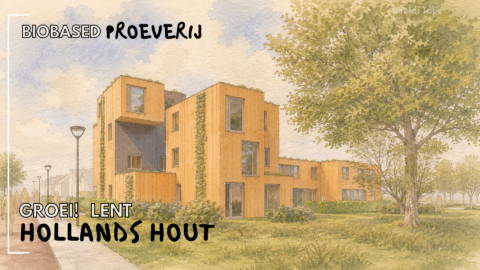
With nearly 60,000 rental units, the Alliantie housing cooperative faces a major renovation task. The idea arose to ask the market for good ideas, and they poured in by the dozen. Twelve homes on Lange Heul and Bijenschans in Bussum have now been sustainably renovated according to the winning concept.
Sam Nederend, what is the goal of De Alliantie?
“Our goal is for the Alliantie to be carbon-neutral by 2050; material-related CO₂ emissions are a key part of that. In new construction, it’s becoming increasingly common to consider the environmental impact of materials, whereas in the past the focus was more on energy. In the renovation sector, there’s much less focus on the CO₂ impact of materials. We’re already working to make our existing homes more sustainable, but we also want to drastically reduce material-related CO₂ emissions. That’s possible through circular renovation, and it’s quite a challenge. We decided to enlist the help of the market and organize a challenge.”
A challenge… did it yield any results?
“Absolutely. We wanted to challenge the market to actively contribute and come up with ideas. It’s a bit like turning the world upside down; normally, as a housing association, you come up with a plan and, through a competitive bidding process, end up with the builder who can carry it out at the lowest cost. In a sense, you’re bypassing the market’s expertise. We, on the other hand, wanted input from all those other parties involved in renovation. There are so many companies and startups developing great ideas. That was evident from the response; we received 36 submissions. From those, we selected six to pitch their ideas.”
RE-DO emerged as the winner. Why?
“Because their concept is sustainable on all fronts, with a maximum focus on bio-based and reused materials. Exactly what we had in mind. The entrant, RE-DO, turned out to be a collective of innovative partners who developed the concept together. They handle everything in-house, and their approach is quite unique. So RE-DO ultimately won the challenge and was awarded the contract.”
In what way was the approach unique?
“Normally, a renovation proceeds ‘horizontally.’ That means a block of townhouses or a floor of a residential complex is renovated layer by layer. In this concept, the approach is ‘vertical’—house by house. This way, the work on each home proceeds faster, and residents experience less disruption. And that’s a key factor in renovations. They can largely stay in their homes. Of course, this only applies if the homes are found to be free of asbestos during the thermal surveys..”
What exactly was done?
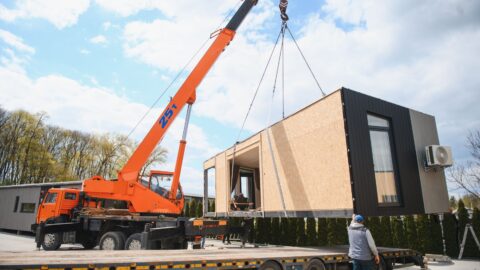
“Solar panels were installed to generate energy, combined with a green roof to promote biodiversity and climate adaptation. We used biofoam beads in the floor and cavity walls. The gable ends are insulated with cork. A new roof structure with flax insulation was installed over the existing roof. On one side, it’s covered with a green roof and solar panels, and on the other side with reused roof tiles. Each home was also equipped with a ground-source heat pump.”
What is the final result?
“It’s all just been completed, and we’re very proud of this project. The homes have been made more energy-efficient in the most circular way possible. The residents are also happy with their ‘new old’ homes. For them, this renovation means their energy bills will drop significantly while their living comfort actually increases. We’re getting a lot of media attention, but other housing cooperatives are also watching what we’re doing.”
Collaboration seems to be the magic word here as well. Is that right?
“Absolutely.” Collaboration is crucial for achieving sustainability on a large scale. You can see that in this concept, which was conceived and implemented by a collective of partners. We ourselves work together with a number of organizations dedicated to making the built environment more sustainable.”
Does the government still play a role?
“The government is investing through the National Growth Fund, thereby driving technological developments in the Netherlands. Among other things, the grant ensures that we can approach project monitoring in a serious and thorough manner. Many different parties make use of the Growth Fund, and that offers all kinds of opportunities for collaboration. This government grant stimulates and connects.”
What makes this make you happy?
“I think it’s really cool that De Alliantie is taking a stand like this. It takes a lot of time and effort to organize a challenge. It’s great to see that there are so many wonderful innovations when it comes to renovation. Look, there aren’t any regulations yet for CO₂ emissions from building materials. For new construction, there’s the MPG requirement, which provides insight into the environmental impact of all materials and systems used in a home or building. This challenge draws attention to that issue for renovation projects. It also shows that De Alliantie, driven by its own intrinsic motivation as a socially responsible organization, is staying ahead of those regulations. It gives me hope for the future.”
How are you going to move forward with this?
“Now that this project has been completed, we’re going to evaluate the circular building materials used. We’ll monitor some of the renovated homes for at least a year to hear about the residents’ experiences and see if the concept delivers on its promises. Ultimately, we’ll evaluate the project and incorporate positive outcomes and findings into future renovations. In any case, this project has shaken up the market a bit. We’re moving full steam ahead with circular renovation, with the goal of achieving carbon neutrality by 2050.”