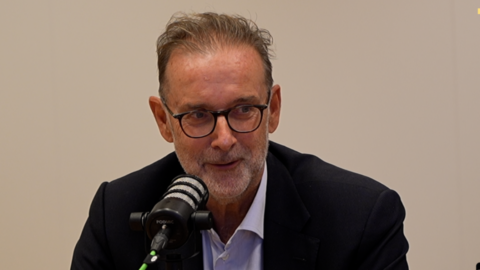
Dredge is our biggest waste stream. Huge volumes have to be disposed of and dumped, at high cost. "My dream is that we will start seeing dredging as a raw material, which you can mine," says Abbe Hekkert of Blue Bagger.
Abbe beams as he looks at his machine, which is in full operation along the side of the Oude Rijn River. It was put in place the day before and in the meantime the first dredge has been delivered. Now it is simmering and separating the various raw materials it contains.
Large and small particles
Abbe shows how he works. First it filters out the larger organic particles and pieces of plastic. Then the dredge goes through a hydrocyclone, in which the small particles, i.e. the clay, go up. The sand goes down, is rinsed clean once more and then falls into a bag. "That's very little now," Abbe says. "Here in the western part of the country it's all clay or peat soil. In other places, that bag fills up very quickly."
If you're going to push wet material into the furnace, you must really be desperateAbbe Hekkert
The clay that goes up is mixed with a starch solution. "We get that from potatoes, so it's completely biodegradable," assures Abbe. The starch causes the clay to clump together and settle better in the machine. In winding tubes, clay and starch are mixed well, before ending up in a large tank in which it can settle. The water comes out on top in an overflow. It is filtered once more, after which it can be returned to the Old Rhine, cleaner than it was. The clay is extracted and led to a tank where the water is squeezed out.
Contaminated dredging
So the dredge is divided into four "fractions," as Abbe calls them. And that has great advantages. Especially if the dredge is contaminated with PCBs and PFAS, for example. "The PCBs and the longer PFAS strings go mainly into the clay," he says. "But PCBs break down when they are heated to 600 degrees. So when that contaminated clay goes into the kiln at the brickyard, it's no longer a problem."
After heating, that clay can also go to the concrete industry, where the sand can also go. "In the concrete industry, there are almost no standards for that. And so then the PFAS is trapped in the concrete. That's much better than moving it to a deep pool from where it can go to groundwater." Finally, the shorter PFAS strings are mostly in the water. "We filter those out at the end. That's the beauty, we deliver the water back cleaner than it comes from the environment."
Huge volumes
Abbe has been working with dredging for four years now, he says. It all started with a challenge. The province of Gelderland had such a big problem with dredge that they even burned the material. "If you're going to push wet material into the furnace, you must be really desperate," Abbe states. "And yet it was the cheapest way to get rid of it. There just wasn't a suitable landfill. Then again, it is the largest waste stream in the Netherlands. It involves huge volumes."
My dream is that we will see dredging as a raw material that you can mineAbbe Hekkert
It is also very expensive to dispose of dredge, especially since it consists largely of water, making it very heavy. For his graduation from TU Delft, Abbe then studied what parts (fractions) dredge consists of, and what kind of dredge comes out of waterways in different places. After his graduation, he and Sil van de Bovenkamp set up the company Blauwe Bagger and began development of the machine that is now running along the side of the Oude Rijn River.
Mining raw material
Through his research into different types of dredging and what it is made of, Abbe knows exactly what to expect from dredging. The machine is primarily intended for the contaminated part of the dredge, because it costs a fortune to get rid of that. But his ambition extends beyond that. "Now everything goes to puddles or to a landfill. There is no consideration at all of what hidden value is in it," Abbe says. "My dream is that we start seeing dredging as a raw material that you can mine."
There's no focus at all on what hidden value is in dredgingAbbe Hekkert
To mine that raw material, you first have to know what's there and you have to be able to make the connection with industry. "Because before we start, we have to take care of marketing," Abbe knows. "What do people want, only when you know that do you have a business case." That case is strengthened by the fact that dumping costs a lot of money, but so does transporting dredge. "You transport half water. That's completely out of the question with us."
Many tests
Meanwhile, the trial is running excellently, Abbe observes with satisfaction. "We now have to start optimizing everything. Now 2 to 3 cubic meters of bager per hour go in and we get 1 cubic meter of raw material out. But it should be 15 in and 5 out."
Meanwhile, the biggest bottleneck is the clay, he knows. "We are experimenting with other presses. Right now there's a chamber filter press in there, but we're looking at alternatives. It will possibly be a decanter, but that is also more expensive and uses more energy. It's still a search and it's a matter of a lot of testing."