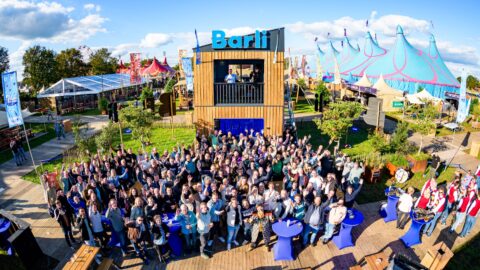
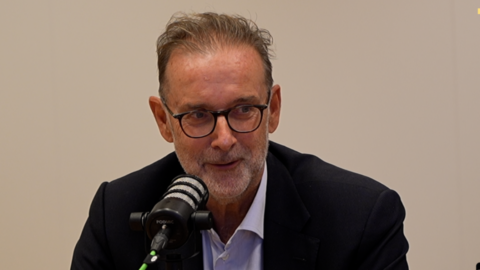
During Project Development Day, I was awarded the Golden Tapir. Ludicrously intended. And it was. But in such a way that I was both put in the limelight and a bit on the spot at the same time. Unprepared, funny questions came at me, and there I stood. With a mouth full of teeth. Or at least: that's how it felt.
And right at that moment, something struck me that I had also seen in colleagues a few weeks earlier. I am someone who has found ways to share knowledge.
Not one way. Several. Sometimes I do it in a button course with the flag bearers. Sometimes in a manual. Sometimes in an internal message. Now in an external piece. Sometimes on a stage. I just see what form is most effective. What works. What sticks. What people need to get moving.
But that Golden Tapir made it clear to me again that that stage is not a natural phenomenon for me. It's a learned trick. And that may be more important than people think.After all, there are people who seem born for a podium. And there are people who are at least as strong in content, sometimes much stronger, but who don't take the podium for granted at all.
Take my colleague Timo Knibbe.
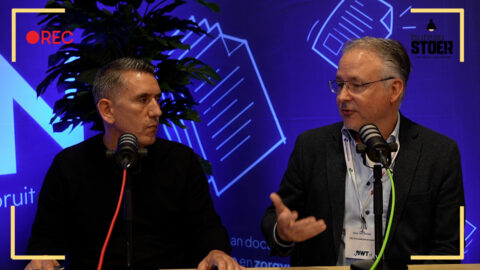
We were recently interviewed for a magazine about AI within VORM Development. Timo found that exciting. And I honestly thought: how can you find this exciting? You simply know more about some parts of AI for tenders than I and the people around us. But right there I saw something that is common: content and visibility are not the same profession. A magazine interview is still the friendly variety. A podium is more exciting. And a stage full of specialists who can fillet you with content is another game altogether.
Or take Paul Strokap.
For me, Paul is one of those people who does the difficult and complex things. He has been a teacher to me for many years, as well as Mark van Stijn. We now work together in a different form, but I still recognize how much of my own base comes from them. With Paul, I see very sharply that sometimes frustration arises precisely from people who have mastered the content best. Paul often plugs the holes for me and for others. He sees the complexity, fathoms the logic and guards the depth. But exactly that type of specialist is not always armed for the political battle that also comes with it. And maybe that is why we are such a good combination: I sometimes pull it out, while he closes it on the inside.
And then there is Mark van Stijn.
Mark is one of those rare, humble, senior guys who is actually hard to place in the landscape of the fast, wild, innovative developer. He is friendly, cheerful, loyal and always helping his colleagues. Not with the verbal abuse I have to put up with, but with calmness, reliability and quality. And perhaps there is something painful in that: such people do not automatically get the stage they deserve. Because the world often reacts faster to volume than to solidity. While I sincerely believe that people like Mark often hold the chain together without ever getting enough recognition for it.
For me, that is the crux of this column.The combination of have content and who can transfer content is rare. Much rarer than we make it seem in the chain.
I work with brilliant people. Inside VORM, outside VORM, at NEPROM, at builders, at housing associations, at consultants. There are really fantastic specialists walking around in this sector. People who know more than I do, are smarter about their subjects than I will ever be, and have gold in their hands in terms of content.
But then take a look at me. See what kind of verbal abuse it apparently takes to explain to others how things can be done. That's not because my content is always better. It is because I have adapted to the reality that knowledge only gets impact when it lands.
And that's an uncomfortable truth for many flag bearers and enthusiasts. No matter how genius your idea is: if you're not understood, nothing will happen. And if you don't find a way - or rather, find multiple ways - to transfer your knowledge, you're left frustrated with a good idea that no one picks up on.
I really know a lot of people who are more advanced in content than I am, but get frustrated because they are not understood. And I get that. Especially if your subject matter is complex. But if you look at me, you actually see the opposite evidence: I often have to explain it at least ten times. In a different form. With a different tone. For a different audience. With jokes. Without jokes. On paper. In a room. In a one-on-one conversation.
So no, you shouldn't be surprised if people don't understand your complex subject matter after you've firmly explained it three times to no avail. That is not necessarily a sign that they are stupid or that your idea is not good enough. It often just means that you haven't yet found the right form to convey it.
Filing moment
Not everyone needs to be on a stage.
But anyone who wants to change the status quo must find a way to be understood.
A good idea that doesn't land is in practice just silence with potential.
And silence doesn't solve a damn thing.