D66 wants to build 10 new cities. Architect Reimar von Meding challenges party leader Rob Jetten to build those cities in the existing city and gives ten suggestions in a letter to him. "Be realistic."
Dear Rob Jetten,
Will we succeed in making room for 10 new cities? Hard to imagine. But neither could we imagine a minority government. Still, it is the most realistic option.
Doing things that no one expects and are realistic. So can the space for 10 new cities. For this you have been looking for new places. But the space is precisely where you least expect it: in the cities that are already built. And it is very realistic to use this space.
1. Did you know that about 70 percent of all households live in neighborhoods built in the postwar period? And did you know that that there is really a lot of unused space in those same neighborhoods? I don't mean parks and beautiful places, but really bad places, concrete flats, where the garbage stays, where you don't want to be after dark. And did you know that if you do nothing but improve these places with new housing everywhere, we could build a city the size of The Hague there with playful ease?
2. Did you know that these same neighborhoods contain corner houses that were once conceived for a family, but now only have one person living in them? If you divide only those corner houses that are suitable for that into two more suitable houses, you can realize a city the size of Maastricht.
3. Did you know that in addition to those corner houses, there are also intermediate houses where the same applies? With only those houses, where the urgency is high and which can easily be rearranged, there is room for all the households of Enschede.
4. Did you know that old porch homes are in need of massive renovations to meet our climate goals? If during these renovations at a small part you make the houses of two large three normal, you can put all of Nijmegen in it.
5. And did you know that from time to time we will also have to change the structure of these neighborhoods? To make them more resistant to climate change, to equip them for sustainable mobility, to make them more nature-inclusive or to adapt the energy grid. If you do this, it will simultaneously create space for so many new households that all of Utrecht 's residents can move in.
6. Do you know all those unsafe edges of neighborhoods where there is no housing, thus no view of public space and we have to read regularly about robberies, rapes and all kinds of unsafe situations? If you make better use of those neighborhood edges, space will be created there in all neighborhoods together for all of Rotterdam.
7. Old garage boxes are everywhere in these neighborhoods. Cars haven't fit in them for a long time. Weed plantations do. If you replace only corporations' garage boxes for housing, a city the size of Groningen could be built on them.
8. Many healthcare complexes are outdated and in need of renovation. They are often on spacious land. If you combine the renewal of care with regular housing, all of Middelburg can be added.
9. District shopping centers everywhere are languishing and taking up a lot of space. If we realize better facilities and new housing in these places, we can have a whole Breda.
10. And: sooner or later we're all going to drive electric. Now make sure that happens. Gas pumps are now often on municipal land and will all go away in the foreseeable future. If you use only the best locations in cities, there will be all of Almere.
So you get the space for 10 new cities: New The Hague, Maastricht, Enschede, Nijmegen, Utrecht, Rotterdam, Groningen, Middelburg, Breda and Almere. All in places where people live who can benefit. You get those cities if you do what no one expects: make the improvement of the existing city important. All you have to do is stop the distraction, waste of time and energy that now goes into new expansion areas.
Be realistic
Help focus on what is realistic, important and socially responsible. It automatically gives you opportunities to tackle big and urgent issues. A housing stock for rapidly changing demographics and household composition. Sufficient housing that is especially affordable for more people. The reduction of CO2 emissions. Taking better care of biodiversity. But also a much more integral opportunity to make the Netherlands robust in dealing with water. Whether it concerns our drinking water safety or the safety of living in a vulnerable delta. Dear Rob Jetten, do what no one expects. Be realistic.
Sincerely,
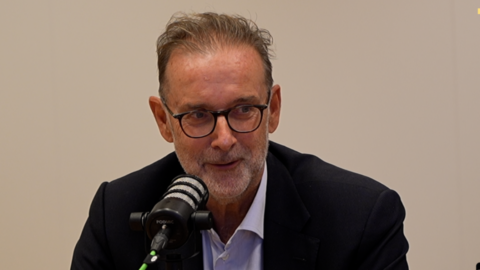
Reimar von Meding, KAW
About Reimar
Reimar von Meding is managing director at KAW Architects, one of the largest architectural firms in the Netherlands. Although the firm is celebrating its 50th anniversary this year, it has never “built” on open farmland. In recent years, KAW has conducted several studies on the smart use of space within the built environment. One of the most recent studies is titled “Space for the Ditch.”
Listen now to an in-depth interview with Reimar about the letter to Jetten on the Bureau Stoer podcast
In response to the letter above, Reimar von Meding is this week’s featured guest on the Bureau Stoer podcast. You can listen to the podcast here. ->