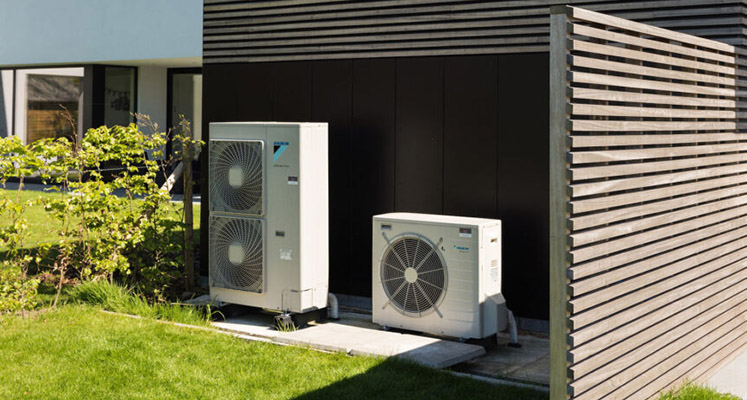
The number of citizens having heat pumps installed in their homes to reduce the use of natural gas has been growing much faster in the last 7 years than the number of homes connected to a collective heat network. Government subsidies exist for both developments in order to get the Netherlands natural gas-free by 2050. "The popularity of the heat pump reduces the chances that plans for new heat networks in neighborhoods with mixed construction are financially feasible," the Court of Audit concludes in a report.
The Court of Audit concludes from research that the Minister of Climate and Green Growth runs the risk of inefficient use of government subsidies due to overlap in both measures. This occurs, for example, in districts in Deventer, Gorinchem, Groningen and Heeg. The minister does not know how much overlap there is in the country.
The Court of Audit's study shows that over 90% of subsidized heat pumps in homes were installed in a neighborhood without a heat grid. Even though the overlap is still small, the Court of Auditors recommends that the minister stop subsidizing a homeowner for a heat pump if it could hinder the development of a heat grid. So says the report published on Feb. 4, 2025 A cold bath for heat networks - Time to adjust the heat transition. By 2023, 160,000 opted for a heat pump to make the home more sustainable, compared to 11,000 new heat network connections. A heat pump in the home typically lasts 15 years.
Little growth in number of heat networks
A collective heat network in a neighborhood or district - also known as district heating - is the best solution for a third of the built environment at the least cost to get the Netherlands natural gas-free by 2050. This was determined earlier by the Netherlands Environmental Assessment Agency. Heat networks are fed by residual heat from industry, geothermal heat or by burning biomass, for example. A heat network lasts much longer than a heat pump. There are now nearly 500 heat networks, mostly smaller ones, with a total of 515,000 connections. Numerous municipalities - especially cities - have plans for expansion or a new heat grid. But several projects have stalled since the end of 2023 because such a grid cannot be operated profitably. Proposals for a new heat bill from the cabinet and its parliamentary consideration will help determine whether that impasse will be broken.
The Court of Audit has mapped data by district. In the De Zuidlanden neighborhood in Leeuwarden, for example, 46 % of the homes are connected to a heat network and 20 % of the homes have purchased a subsidized heat pump (the remaining homes have a central heating boiler or are heated differently). In the Witbrant neighborhood in Tilburg, 85 % of the homes are connected to collective district heating and 10 % have individual heat pumps. There are numerous residential neighborhoods where there is no heat network (planned).
Low growth in number of connections to heat grid
The number of new connections to a large heat network increased by 11,000 in 2023. This falls far short of the government's target of 500,000 new connections by 2030. The central government has had at least €1.1 billion available through various subsidy schemes before 2024 to stimulate the heat transition. The Court of Audit recommends exploring forms of financing other than subsidies for the unprofitable top in the construction of heat infrastructure.
High fixed costs with heat grid
Homeowners and tenants are not always enthusiastic about connecting to a heat grid. The heat company that operates a network in a neighborhood is a monopolist; switching to another company is not possible. Furthermore, realizing a heat network takes years. The level of fixed costs for district heating/heat grid also leads to discussion. Until 2024, the regulator Authority Consumer and Market could not offer sufficient protection to consumers against unjustified rate increases by heat companies, the Court of Auditors says. Until recently, the ACM only had insight into the efficiency of the heat sector as a whole. Since this year, the ACM can correct tariffs if a specific heat supplier achieves a more than reasonable return. Whether an efficiency test is sufficient remains to be seen.
Evaluate funding importance, ensure support
The response of the Ministers of Climate and Green Growth and of Housing and Spatial Planning to this study to seek other forms of financing for the heat transition that is stagnating, the Court of Audit finds positive. But not all conclusions and recommendations are endorsed. For example, the efficiency test for heat networks deserves an evaluation, as the ACM also endorses. Whether this is sufficient requires further consideration.
For public support it is important that citizens also experience the transition to and costs of heat sources other than natural gas as fair. The Netherlands Scientific Council for Government Policy (WRR) endorses this plea on the affordability of heat.

This is an article from Construction and Installation Hub. Want to keep up with all the news from the construction and installation industry? Then take a look at the hub and sign up for the online community.
↗