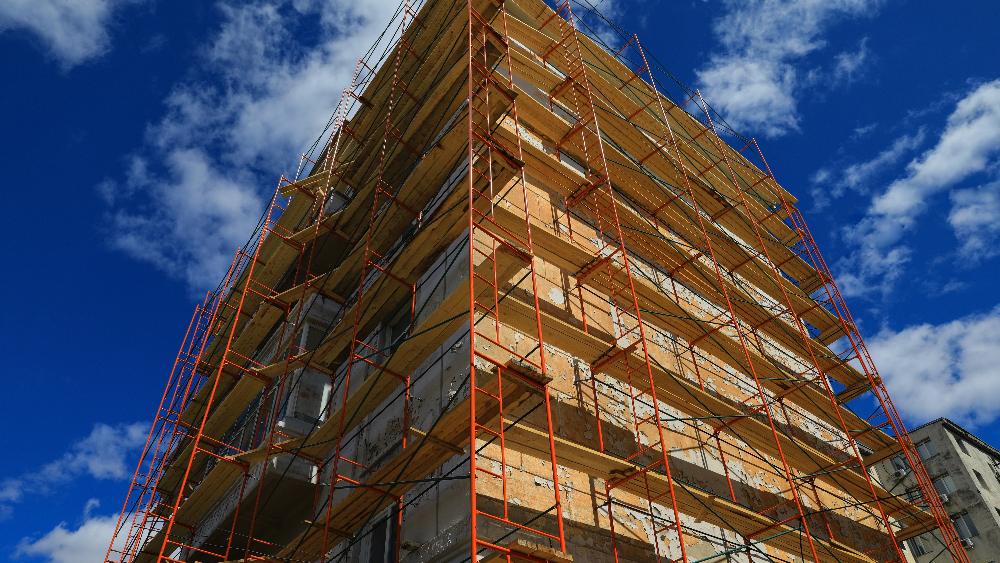
The fact that adding stories to existing buildings has not proven to be the silver bullet for the housing shortage does not automatically mean that the solution lies solely in new neighborhoods, argues Jan Willem van de Groep in this issue of Zichtlijnen. “There is still a considerable range of options between adding an extra story to an apartment building and building an entirely new neighborhood.”
The Economic Institute for Construction (EIB) released a rather sobering report this week on making better use of the existing housing stock. According to the EIB, we are overestimating the enormous potential for housing subdivision, transformation, and—above all—adding stories, while the actual numbers have remained low for years. Splitting homes yields approximately 2,000 additional homes per year, and adding stories to existing buildings is estimated to yield 500 to 600 homes. The total increase in housing supply from the existing stock has also been declining rather than increasing in recent years.
As far as I’m concerned, the EIB has a valid point here. Theoretical potential doesn’t equate to actual output. On a map, a flat roof quickly becomes a construction site, and you can easily split a large home in half in Excel. In practice, however, there are residents, ownership structures, building structures, utilities, access, fire safety, parking, and a business case to consider. From my time as a contractor, I’ve renovated enough existing buildings to know how quickly something that looks simple on paper can become complicated in practice.
Still, I think the step the EIB takes next is too big. Just because something isn’t happening much now doesn’t automatically mean it can’t happen much more. Part of the system is actually being adjusted right now. Rotterdam, for example, has this year established a new framework for adding stories to existing buildings, adjusted the minimum housing size, abolished the compensation paid to the municipality for affordable units added to existing buildings, created opportunities to deviate from parking standards, and organized support for homeowners’ associations. All of this is fairly recent. It seems a bit premature to me, then, to infer where the upper limit lies based on the production figures from recent years.
But perhaps that isn’t even the most important point to note in this discussion. Reimar von Meding of KAW responded on LinkedIn, noting that adding stories and subdividing properties actually play a very minor role in their studies. In *Ruimte Zat*, KAW even assigned a value of zero to adding stories, because it has relatively little potential. That’s remarkable, because adding stories has now almost become the poster child for making better use of the existing city.
I found his second point even more interesting. According to him, when housing cooperatives undertake maintenance and renovation projects, it is still far from standard practice to consider whether new housing units can be added at the same time. Not because it’s structurally impossible, but because a maintenance department is, after all, not a development department and approaches a complex from a different perspective. When KAW does incorporate that question from the outset in such a project, he says that adding 20 to 30 percent more units is often possible.
In my view, this is a far more important path than yet another discussion about 100,000 homes on flat roofs. In the coming decades, we’re going to invest enormous sums in the existing housing stock anyway. Foundations need to be repaired, homes made more sustainable, systems replaced, and complexes adapted to changing housing needs. At all these stages, architects, structural engineers, housing authorities, municipalities, and contractors are already working on such buildings anyway. So why not routinely explore whether housing units can be added at the same time?
That doesn’t always have to mean adding stories. Perhaps large homes could be reconfigured, unused ground-floor space could be utilized, an extension could be added to a building, or garage units could be replaced. Perhaps, in the case of a major restructuring, a completely different subdivision plan would be smarter. And sometimes there’s simply space next to an existing complex where you can build new homes. These are all ways to make more intensive use of the existing city, without turning every flat roof into a construction project.
This also makes the distinction that is often drawn today between the existing housing stock and new construction somewhat artificial. A significant portion of what we call “making better use of the existing city” is, in the end, simply new construction. It just takes place between, next to, or in place of existing buildings. Sometimes this is easier to achieve than building outwards, and sometimes it’s very complicated. In my view, the EIB study convincingly shows that we won’t solve the housing shortage through subdivision and adding stories alone. But that doesn’t mean the remaining homes must be built only on the outskirts of cities and towns. There’s still a considerable range of options between adding an extra floor to an apartment building and building an entirely new neighborhood.
There’s another practical reason to take a closer look at this. It’s not just land and money that are scarce—people are, too. Municipalities have a limited number of permit issuers and technical staff. Housing cooperatives have limited development capacity. Engineers, architects, and contractors can only devote their time to one project at a time. So you have to ask not only whether a project is technically feasible, but also how many homes it will yield, how much capacity it will require, and how long it will take for those homes to be built.
This can work both ways. It makes little sense to organize enormous amounts of resources around complex infill projects that ultimately yield only a limited number of housing units, when those same people could achieve much more elsewhere. But if a housing authority is going to renovate a complex at a cost of tens of millions anyway, and by taking a slightly smarter approach at that point you can add 20 percent more housing units, it’s just as strange to let that opportunity slip by.
Perhaps that is why we need to move away from programs that start with the solution. No target of so many thousand rooftop units, after which we have to search everywhere for suitable roofs. No theoretical calculation in which every spacious home is already designated for future subdivision. For every major intervention in a residential complex, neighborhood, or urban location, simply ask as a matter of course whether more and better-suited housing units can be created at the same time.
Sometimes the answer is to add another story. Sometimes it’s to subdivide, expand, transform, or restructure. And sometimes you have to conclude that it’s too complicated and that it’s better to allocate your people and resources elsewhere. I think the idea of making better use of the existing city is excellent. We just have to be careful not to confuse it with a few solutions that just happen to fit neatly into a policy framework.