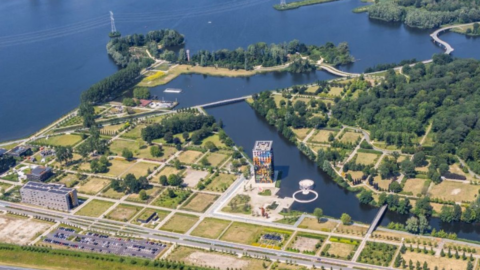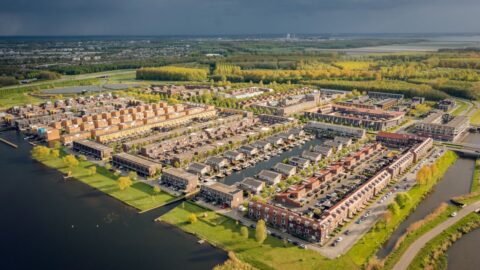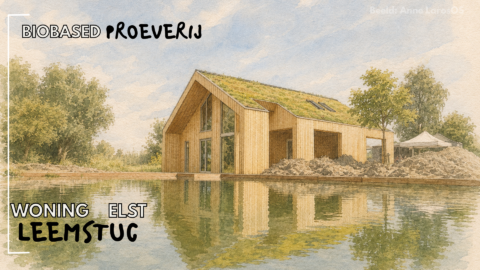
A home built today will likely still be standing in 2070—or beyond. Yet when it comes to new construction, we still largely rely on climate data from the past. As summers get hotter, downpours become more intense, and dry spells last longer, the question arises: shouldn’t we start designing in a fundamentally different way?
We posed these—and other—questions to three experts. They agree on one thing, at least: we can’t afford to wait until building codes catch up with reality.
Preparing for extreme conditions
“2050 is the absolute minimum.” To Andy van den Dobbelsteen, it’s actually strange that we don’t look much further ahead when it comes to new construction. As a professor of Climate Design & Sustainability at Delft University of Technology, his research focuses on topics such as sustainable energy and climate adaptation in the built environment. “Any self-respecting builder assumes that his house or building will stand for at least fifty years. It would be wiser to look at what’s expected by 2070 and beyond.”
That’s not happening enough right now. According to Van den Dobbelsteen, a major cause lies in the climate data used in building codes. “They look at the average over the past few decades and are thus effectively looking backward. Meanwhile, buildings need to be prepared for more extreme conditions: more summer heat, longer droughts, and heavier rainfall.”
First the design, then the systems
The building designer plays a key role in this. Architect Tim Vermeend is the founder and creative director of Urban Climate Architects, and his firm focuses heavily on timber construction and sustainable inner-city development. His guiding principle: a building should have as little negative impact as possible and, wherever possible, leave the site in better condition than he found it.
His answer to this issue, therefore, doesn’t start with more systems, but with smart design. According to Vermeend, that begins outside the building. “Sufficient greenery can lower temperatures in urban areas, after which, at the building level, sunshades, shade, building mass, and smaller window areas can prevent heat from entering in the first place.”
According to Vermeend, all we need to do to find solutions is look south. “If we drive two thousand kilometers, we’ll be at the border of Portugal or southern Italy. People live there, too. So knowledge about building for a warmer climate already exists. That leads to surprisingly simple questions: Should a roof be black? Can we use more reflectivity? And do windows always have to be that big?”
In his view, it is precisely these kinds of low-tech solutions that deserve more attention. “We’re too quick to turn to systems to solve the problem, while some aspects of our design simply aren’t quite right yet.”
Don’t wait for regulations
Architectural consultant Harm Valk also sees a problem there. This summer, after nearly 29 years, Valk retired from Nieman Raadgevende Ingenieurs, where he became an expert in the field of energy performance and sustainability. He remains active, among other things, as vice president of REHVA and in providing specialized consulting services.
His answer to the question of whether current building codes are sufficiently equipped to handle the climate of thirty or fifty years from now is brief: “No, of course not.” He explains that he doesn’t find this surprising, though. “For decades, looking back made sense because the climate was relatively stable. Moreover, the Netherlands designed buildings primarily to keep them warm. Now, a new reality is emerging in which cooling needs and overheating are playing an increasingly important role.”
Regulations are evolving, but slowly. And that’s exactly where the problem lies. “We can’t afford to wait for laws and regulations. That’s actually my most important message.”
Standard sun protection
What can the sector do in the meantime? The three experts consistently arrive at the same measures: greenery, shade, and—above all—preventing solar heat from entering the building. Valk puts it bluntly: “How about we start by installing standard exterior sunshades everywhere? How about we stop this little competition to see who can create the largest glass openings?”
According to him, architects don’t need to install screens everywhere; sun protection can just as easily be part of the building’s design. “Realize that the solutions that worked perfectly ten years ago might not work as well in the future.”
Van den Dobbelsteen takes it a step further. “Urban planners also need to start designing differently. Greenery, running water, and enough space for overhangs and shade can significantly influence the temperature around buildings. If greenery isn’t possible, light-colored facades and white roofs, for example, can help.”
Ultimately, the regulations will change as well. Valk expects that future climate data will find its way into energy performance and overheating calculations, among other things, causing measures against summer heat to naturally carry more weight. “But the home that will be completed in a few years is already being designed today. And so the first step isn’t in The Hague, but on the drawing board.”